Wednesday, July 7, 2021

Postcolonial studies and bollywood

Helloo my dear readers...
In this blog I would like to talk about one movement Postcolonialism. And one intresting thing is that I would like to see this term in different way means in this blog we should see postcolonial in bollywood.
So let's start...

Watching movies for entertainment and watching movies for study purposes is a very different task. Because the way we are watching it indicates our thinking ability to see any particular matter. So in this blog I'm going to discuss postcolonialism in two Bollywood movies. The first is "Lagaan" and the second is "Rang De Basanti". So let's discuss about it. 

Before understand postcolonialism in movie we have to clear our concept of what postcolonialism is?

Firstly We talk about this movement :-
Postcolonialism:-
Postcolonialism is the historical period or state of affairs representing the aftermath of Western colonialism; the term can also be used to describe the concurrent project to reclaim and rethink the history and agency of people subordinated under various forms of imperialism. Postcolonialism signals a possible future of overcoming colonialism, yet new forms of domination or subordination can come in the wake of such changes, including new forms of global empire. Postcolonialism should not be confused with the claim that the world we live in now is actually devoid of colonialism.

"Postcolonialism... involves a studied engagement with the experience of colonialism and its past and present effects"

So let's have a look at Postcolonial elements in both movies. 
1) Lagaan
2)Rang de Basanti

1) Lagaan:-
Lagaan (transl. Agricultural tax), released internationally as Lagaan: Once Upon a Time in India, is a 2001 Indian Hindi-language epic musical sports film written and directed by Ashutosh Gowariker, and produced by and starring Aamir Khan, along with debutant Gracy Singh and British actors Rachel Shelley and Paul Blackthorne in supporting roles. Made on a then-unprecedented budget of ₹250 million[2] (US$5.32 million),[3] the movie was the maiden project from Aamir Khan Productions and was shot in villages near Bhuj.
The film is set in 1893, during the late Victorian period of India's colonial British Raj. The story revolves around a small village in Central India, whose inhabitants, burdened by high taxes, and several years of drought, find themselves in an extraordinary situation as an arrogant British army officer challenges them to a game of cricket, as a wager to avoid paying the taxes they owe. The narrative spins around this situation as the villagers face the arduous task of learning a game that is alien to them and playing for a result that will change their village's destiny.

Lagaan released on 15 June 2001, clashing with Gadar: Ek Prem Katha starring Sunny Deol and Ameesha Patel. Lagaan received widespread critical acclaim and awards at international film festivals, as well as many Indian film awards. It became the third Indian film to be nominated for the Academy Award for Best Foreign Language Film after Mother India (1957) and Salaam Bombay! (1988).

Postcolonial study of the film :-

In this above picture  we can see that the people are growing seeds in their farm, with their hard work and the benefits taken by the King and British people. They have to give them Lagaan. It shows how British people are plundering them. 

Here we can say that indian king meet Elizabeth and speck with him in Hindi but she can not understand hindi language.here we can say that they British people most of don't know our language but our people speak English very well. This language is the also a part of postcolonialism.
In this movie we can say that British officer put a one deal with king and said if they eat meat Than he talk with other king to less a text. But king said that
" I cannot betray my religion for my duty." 
Here we can see that how British people try to control indian people.
In the movie we can see that white people have their own way of looking at Indian people. They think that we are only their servants. We were born to be slaves. As well as Indian people have their own way of looking at lower caste people. The upper class people think that they are our servants. They are untouchables. So this conflict is seen in the movie. 

The other thing which is pivotal is the character of Lakha and the character of Elizabeth. We can think that we all are good and all Britishers are bad. But it is not so, because there are some good people and things in Britishers and there are bad people and things in Indians also. Like Lakha, he helped the Britishers because he was jealous of Bhuvan.

2) Rang de Basanti:-
The film follows a British film student traveling to India to document the story of five freedom fighters of the Indian revolutionary movement. She befriends and casts five young men in the film, which inspires them to fight against the corruption of their own government. It features an ensemble cast consisting of Aamir Khan, Siddharth, Atul Kulkarni, Soha Ali Khan, Sharman Joshi, Kunal Kapoor and British actress Alice Patten. The film was shot primarily in New Delhi.

The film was released globally on 26 January 2006, the Republic Day of India. Upon release, the film broke all opening box office records in India, becoming the country's highest-grossing film in its opening weekend and holding the highest opening-day collections for a Bollywood film. It received critical acclaim, winning the National Film Award for Best Popular Film, and being nominated for Best Foreign Language Film at the 2007 BAFTA Awards. Rang De Basanti was chosen as India's official entry for the Golden Globe Awards and the Academy Awards in the Best Foreign Language Film category, though it did not ultimately yield a nomination for either award. A. R. Rahman's soundtrack, which earned positive reviews, had two of its tracks considered for an Academy Award nomination. In India, Rang De Basanti won Best Movie at the Filmfare Awards.

Postcolonial study of the film :-
when Sue has come to India, at the airport all taxi drivers encircle her with excitement. It shows Indian mindset and impact toward white people. If we go out of country that we find that they don't behave like this. This call postcolonialism.
Violence and separation of power is shown in the movie as a postcolonial element. In our country out political situation is very bad. All are currepted people and in movie we can see that when ajay died in plane crush that government blame him infact of accept their mistake. This is shown our government's decision.
in this movie we cann see that When the students are shot at a radio station. The authorities proved them as terrorists ! They said that they are the terrorists and they were shot now the public are safe. But we know the real story, that they are not terrorists, they are true students. Even they want to awaken all people to what is going wrong with all people. But they choose a path of violence. 
 One is that Specking style and sense of sue is amazing.
when Sue speaks Hindi, DJ is shocked, because he thinks that white people can not speak and understand Hindi. This is a single story in our mind also. We think the white people can not speak our language. 

The education topic is also a pivotal element of postcolonialism here. Karan's father wants Karan to study in foreign. This is our mindset that foreign countries have the best education systems. It is quite true also, but India also has the best education system also.
Thank you...


Sunday, July 4, 2021

Sunday Reding:- Chimamanda Ngozi Adichie

Helloo readers...
This blog is the part of my thinking activity in classroom. In this blog I would like to talk about the famous Nigerian writer Chimamanda Ngozi Adichie. And ponder some points and gave my rivew on that.

Let's throw some light on her Life.
Chimamanda Ngozi Adichie:-

Chimamanda Ngozi Adichie, (born September 15, 1977, Enugu, Nigeria), Nigerian author whose work drew extensively on the Biafran war in Nigeria during the late 1960s.

In 1998 Adichie’s play For Love of Biafra was published in Nigeria. She later dismissed it as “an awfully melodramatic play,” but it was among the earliest works in which she explored the war in the late 1960s between Nigeria and its secessionist Biafra republic. She later wrote several short stories about that conflict, which would become the subject of her highly successful novel Half of a Yellow Sun (2006). As a student at Eastern Connecticut State University, she began writing her first novel, Purple Hibiscus (2003). Set in Nigeria, it is the coming-of-age story of Kambili, a 15-year-old whose family is wealthy and well respected but who is terrorized by her fanatically religious father. Purple Hibiscus garnered the Commonwealth Writers’ Prize in 2005 for Best First Book (Africa) and that year’s Commonwealth Writers’ Prize for Best First Book (overall). It was also short-listed for the 2004 Orange Prize (later called the Orange Broadband Prize and now the Baileys Women’s Prize for Fiction).

Adichie’s nonfiction included We Should All Be Feminists (2014), an essay adapted from a speech she gave at a TEDx talk in 2012; parts of the speech were also featured in Beyoncé’s song “Flawless” (2013). Dear Ijeawele, or A Feminist Manifesto in Fifteen Suggestions was published in 2017. Following the death of her father, Adichie wrote Notes on Grief (2021), in which she mourned his passing and celebrated his life.

1. Did the first talk help you in understanding of postcolonialism?
Yes, Chimamanda Ngozi Adichie's first talk helped use In understanding postmodernism. In her talk we can easily find the aspects of postcolonial criticism. Adichie's talk is about how Americans consider African people. In her talk we came to know about four critical aspects.
She talks about Cross-cultural interaction.
1)Identity 
2)Language
3)Hybridity and lots of things. 
In this video she talks about the power which narrates the story and condition also the mind of people. she says that single story will create a archetype and archetypes are dangerous because they are incomplete.
However, she says that when we reject a single story when we realized that there is not a single story but we regain a kind of paradise.

2. Are the arguments in the seconds talk convincing?


Yes the arguments in this video whatever she takes his concerning. In this video she talks about feminism. She mentioned one incident from one hotel. She walking alone in and one waiter consider her as sex worker. She felt angry. Then she talked about in Nigeria how women were treated. She talked a lot about how men were superior and women considered inferior.
Meanwhile, she differs one quote By Simone De Beauvoir '' one is not born rather becomes a woman''. she says that gender differential is worst things.

3. What did you like about the third talk?


The third talk I like the most is her satire on one lady who pronounced her name incorrectly. 

A few years ago, I spoke at an event in London. The English woman who was to introduce me had written my name phonetically on a piece of paper. And backstage she held on tightly to this paper while repeating the pronunciation over and over. I could tell, she was very eager to get it right.

And then she went on to the stage and gave a lovely introduction and ended with the words “Ladies and gentlemen, please welcome Chimichanga.”

I told — I told this story at a dinner party shortly afterwards. And one of the guests seemed very annoyed that I was laughing about it. “That was so insulting”, he said, “that English woman could have tried harder.”

But the truth is she did try very hard. In fact, she ended up calling me a fried burrito because she had tried very hard and then ended up with an utterly human mistake that was the result of anxiety.

4. Are these talks bringing any significant change in your way of looking at literature and life ?
Yes,these talks bring changes in my way of looking at literature. its Change my view that I always believe that literature is always for reading and listening but after hearing this lady it's change my mind toward the literature. If we look around us than literature is everywhere.
Thank you...


Thinking activity:-Shashi Tharoor: Dark Era and Reparation From British Raj

Hello readers...
This is the blog of my thinking activity in classroom. In this blog I would like to ponder some points which is given by our professor Dilip sir and try to gave my interpretation. 
In this blog I would like to talk about the famous writer Shashi Tharoor and his famous work"An Era off Darkness".
Click here to more information about the task.

Firstly we throw some light on writer:-
Shashi Tharoor:-
Shashi Tharoor he was born 9 March 1956.He is an Indian politician, writer and a former career international diplomat who is currently serving as Member of Parliament, LokSabha from Thiruvananthapuram, Kerala, since 2009.At the age of 22, he was the youngest person at the time to receive such an honor from the Fletcher School. 
                   Tharoor began his political career by joining the Indian National Congress and successfully represented the party from Thiruvananthapuram, Kerala by winning in the Lok Sabha elections and becoming a Member of Parliament. Tharoor is an acclaimed writer, having authored 18 bestselling works of fiction and non-fiction since 1981, which are centered on India and its history, culture, film, politics, society, foreign policy, and more related themes.
               The UK edition rose to Number 1 in the London Evening Standard bestseller lists. Since then, he has published two other non-fiction books: Why I Am A Hindu (2018) and The Paradoxical Prime Minister (2018), both of which have been published in the Indian subcontinent by Aleph Book Company.

key arguments in Shashi Tharoor's book - An Era of Darkness:-
  In the his work " An Era of Darkness " Shashi Tharoor mostly doing arguments to established about British colonial rites whose violence experience for Indian society.
Here we can see that most off the his work represented on British exploitation of India so that he carried the day for Tharoor in an Oxford debate not too long ago.
He know about the Indian people and society.Thus he explain very well about the situation.

           In Tharoor an era of darkness for India which suffered through wars, made man famines,racism,deportation..etc. 
So here Tharoor's debate became popular.
 We very well know that British government everything was doing for increased own wealth from India but they gave us new more things.He try to explain this idea by his view.
He also famous as a for debate.

Write critique on both the films with reference to postcolonial insights.

The black Prince:-
The Black Prince is a 2017 international historical drama film directed by Kavi Raz and featuring the acting debut of Satinder Sartaaj. It tells the story of Duleep Singh, the last Maharajah of the Sikh Empire and the Punjab area, and his relationship with Queen Victoria.
The Black Prince is an emotional drama based on the true story of the last king of Punjab, Maharajah Duleep Singh, starring musician and poet, Satinder Sartaaj. ... Amidst political turmoil at the height of the British Empire, Duleep Singh was sent to Britain, where Queen Victoria took him under her wing.
 We learn one thing is that the oppressed will always come to a point when they will rise against oppression and their voices will be heard. I think this film offers that perspective, that the right voice needs to be heard.

Victoria and Abdul:-
The movie is based on a true story about Queen Victoria that wasn't even told until 2010, when journalist Shrabani Basu published “Victoria & Abdul: The True Story of the Queen's Closest Confidant.” Queen Victoria (Judi Dench) is lonely, sad and tired.He teaches the empress of India about the Koran and instructs her in Urdu, and the two become close. Upon Victoria’s death in 1901, a group of royals evict Abdul and his family from their house on the grounds of Windsor Castle, burn letters from the queen and set about erasing Abdul from existence.

Erasure is a grievous sin, and shedding light on stories that have long been in darkness is at least a partial atonement. “Victoria & Abdul” not only sheds light on the long-forgotten relationship, it bathes it in a loving, golden glow that shimmers with nothing but warmth and kindness.
In this both movie we find postcolonial insights.

Summarise Ngugi Wa Thiongo's views in 'Introduction: Towards the Universal Language of Struggle' - from 'Decolonising the Mind: The Politics of Language in African Literature'.

Colonize and Decolonization the Mind is a collection of essays about language and its constructive role in national culture, history, and identity. The book, which advocates for linguistic decolonization, is one of Ngũgĩ’s best-known and most-cited non-fiction publications, helping to cement him as a pre-eminent voice theorizing the “language debate” in post-colonial studies.By his view we can try to understand about the colonize person.

     In other idea about it we can see in African society struggle a lot for liberate their economy, politics and culture. We know that Africa still living as obviously economic and political despite. In Africa mostly people speak in English, french, Portuguese.This is a very useful for better understanding.
Thank you...


Thursday, June 24, 2021

Thinking activity:-An Artist of the Floating World - Kazuo

Hello readers...
This blog is the part of my thinking activity in classroom. In this blog I would like to talk about one famous novel An Artist of the Floating World by Kazuo.so let's see first about the Novel.
Kazuo Ishiguro :-
Sir Kazuo Ishiguro (born 8 November 1954) is a British novelist, screenwriter, musician, and short-story writer. He was born in Nagasaki, Japan, and moved to Britain in 1960 when he was five. Ishiguro is one of the most celebrated contemporary fiction authors in English. He has received four Man Booker Prize nominations and won the award in 1989 for his novel The Remains of the Day. Time named Ishiguro's novel Never Let Me Go the best novel of 2005 and one of the 100 best English-language novels published between 1923 and 2005.

In 2017, the Swedish Academy awarded Ishiguro the Nobel Prize in Literature, describing him in its citation as a writer "who, in novels of great emotional force, has uncovered the abyss beneath our illusory sense of connection with the world".

 
About novel:-
An Artist of the Floating World (1986)[1] is a novel by Nobel Prize-winning British author Kazuo Ishiguro. It is set in post-World War II Japan and is narrated by Masuji Ono, an ageing painter, who looks back on his life and how he has lived it. He notices how his once great reputation has faltered since the war and how attitudes towards him and his paintings have changed. The chief conflict deals with Ono's need to accept responsibility for his past actions, rendered politically suspect in the context of post-War Japan. The novel ends with the narrator expressing good will for the young white-collar workers on the streets at lunchbreak. The novel also deals with the role of people in a rapidly changing political environment and with the assumption and denial of guilt.
The novel is considered as both historical fiction and global literature (Weltliteratur).[2] It is considered historical fiction on account of its basis in a past that predates the author's own experiences, and it draws from historical facts. It is also considered global literature on account of its broad international market and its thematicisation of how the world today is interconnected.

1. 'Lantern' appears 34 times in the novel. Even on the cover page, the image of lanterns is displayed. What is the significance of Lantern in the novel?
Lanterns are the symbol of the floating world. They represent the fleeting beauty and warmth of nightlife as well as the transience of the traditional way of life in Japan, which vanishes after the war. Lanterns are the old-fashioned, welcoming source of soft light at Mrs. Kawakami's. Within their spheres of light Masuji Ono is embraced. 

2. Write about 'Masuji Ono as an Unreliable Narrator'?
An Artist of the Floating World is a masterpiece that glides in out and of many dimensions. On the one hand, it is a story of generations separated by a massive ideological gulf. On the other, it is about an older man attempting to come to terms with his mistaken philosophies. It is also a historical fiction set in the Japan of limbos; Japan, which has suffered because of its misplaced imperialism, been shattered by bombings and is now critical of the past and every person representing it. At the heart of it is an unreliable narrator, Masuji Ono. Once an acclaimed painter, Ono is our guide through post-World War II Japan and its sociopolitical and emotional trauma; felt in extremities like the once-vibrant pleasure districts destroyed by bombings and kids who loved Popeye and Godzilla.
The book is a contemplative journey.
3. Debate on the Uses of Art / Artist (Five perspectives: 1. Art for the sake of art - aesthetic delight, 2. Art for Earning Money / Business purpose, 3. Art for Nationalism / Imperialism - Art for the propaganda of
 Government Power, 4. Art for the Poor / Marxism, and 5. No need of art and artist (Masuji's father's approach):-

Art is a central theme of the novel, with One's role as a propaganda artist being the chief storyline. The novel questions the ability of art to influence and inspire political action within a community. There is a large conflict between whether art should be politicized or whether it should be simply a source of pleasure and gratification.Art for the sake of art - aesthetic delight When summarized in this way, the novel sounds misleadingly like the depiction of a straightforward decline: as if Ono’s artistic ambition leads him first to aloof and implicitly elitist aestheticism, and then from aestheticism to overtly elitist fascism, as Walter Benjamin might have predicted:
“Fiat ars – pereat mundus”, says Fascism, and, as Marinetti admits, expects war to supply the artistic gratification of a sense perception that has been changed by technology. 


4. What is the relevance of this novel is our times?
In our time we find the same thing which we see in novel. Self-Perception, and Self-Deception are also we can see in our time.We also faced problem like Family Reputation, Family Secrets, and Familial Loss. In our t
Intergenerational Conflict are more we find in today's time.this novel is basesd on City, Nation, History.Also, According to countries people what's Nationalism? what do you believe if I know that there are so many soldiers, who will die for country. we can say that this is the true Nationalism but In my opinion like you can invent any new things from your own mind and gives for country so that's also Nationalism.
This time is also very relevant with the Floating world. We can say that we are living in a floating world. Specially after this pandemic we can say that we all are in that kind of situation when we all are floating in air. 
Thank you....

Wednesday, June 23, 2021

Thinking Activity: George Orwell's 1984

Hello readers...
In this blog I would like to talk about the famous novel 1984 by George Orwell. This blog is part of my thinking activity in classroom work.
About novel:-
Nineteen Eighty-four, also published as 1984, novel by English author George Orwell published in 1949 as a warning against totalitarianism. The chilling dystopia made a deep impression on readers, and his ideas entered mainstream culture in a way achieved by very few books. The book’s title and many of its concepts, such as Big Brother and the Thought Police, are instantly recognized and understood, often as bywords for modern social and political abuses.

Here are my responses on the various points:-

 What Dystopian Fiction?
Dystopian fiction offers a vision of the future. Dystopias are societies in cataclysmic decline, with characters who battle environmental ruin, technological control, and government oppression. Dystopian novels can challenge readers to think differently about current social and political climates, and in some instances can even inspire action.
Characteristics of Dystopian Fiction:-
The central themes of dystopian novels generally fall under these topics:

1)Government control
2)Environmental destruction
3)Technological control
4)Survival
5)Loss of individualism

Dystopias are societies in cataclysmic decline, with characters who battle environmental ruin, technological control, and government oppression. Dystopian novels can challenge readers to think differently about current social and political climates, and in some instances can even inspire action.

Is 1984 dystopian fiction?:-
George Orwell’s 1984 is a defining example of dystopian fiction in that it envisions a future where society is in decline, totalitarianism has created vast inequities, and innate weaknesses of human nature keep the characters in a state of conflict and unhappiness.
The novel 1984 is a dystopian novel that tells the story of Winston Smith and how is tries to rebel against the totalitarian state in which he lives. ... Orwell wrote 1984 to warn society about what would happen if we accept totalitarian governments into society.
In 1984, Orwell creates a technologically advanced world in which fear is used as a tool for manipulating and controlling individuals who do not conform to the prevailing political orthodoxy. In his attempt to educate the reader about the consequences of certain political philosophies and the defects of human nature, Orwell manipulates and usurps the utopian tradition and creates a dystopia, a fictional setting in which life is extremely bad from deprivation, oppression, or terror. Orwell's dystopia is a place where humans have no control over their own lives, where nearly every positive feeling is squelched, and where people live in misery, fear, and repression.
It's a dystopian novel, which means that Orwell speculates on the future by emphasizing the ways a present situation could turn ugly. Unlike utopias and utopian fiction, which imagine a perfect and idealized society, dystopias dramatize the many ways things could go wrong. War could break out. The government could watch us on a massive surveillance system. 
Q.2 your learning about the novel from online screening of the film:-

Screening helps us to understand so many things. The novel 1984 by George Orwell is one of the interesting novel and we also did a screening of this novel. Such things are very clear to understand with help of screening. In this work screening helps to understand such a situation of dystopian society. How people were brainwashed and how everyone obeyed particular parties it’s clear to mind. It throws light on so many things. Whatever we see is more memorable than we watch.


Here in this screenshot we can say that big brother is always watching them.and they try to ruled them.
In this picture you can see that all mens hands are crossing and they said that two minutes hate and they said "B". Here Big brother is on screen and try to control all and by his side.

This picture described that how the party of big brother brainwashing the protagonist Winston Smith.By using this they wants people's favour towards their party.

What according to you is the central theme of this novel? :-
If we focus on theme that in it o find one Central theme it is Totalitarianism. It  is one of the major themes of the novel, 1984. It presents the type of government where even the head of the government is unknown to the public. This theme serves as a warning to the people because such regime unleashes propaganda to make people believe in the lies presented by the government.
           Throughout the novel, there is no proof of Big Brother’s existence in Oceania. The Party exercises complete control not only on the sexual lives of their citizens such as Julia’s and Winston Smith but also on their thoughts, feelings and even writing a diary. The overall monitoring and surveillance of the people through telescreens and subversion of history through the Ministry of Truth are some of the common casualties of such regimes. The third casualty of the totalitarianism is the truth through language. This happens in the shape of mottos such as “War is Peace.”
Orwell designed 1984 to sound the alarm in Western nations still unsure about how to approach the rise of communism. In 1949, the Cold War had not yet escalated, many American intellectuals supported communism, and the state of diplomacy between democratic and communist nations was highly ambiguous. In the American press, the Soviet Union was often portrayed as a great moral experiment. 

What do you understand about the term 'Orwellian'?
Orwellian" is an adjective describing a situation, idea, or societal condition that George Orwell identified as being destructive to the welfare of a free and open society. ... The New York Times has said the term is "the most widely used adjective derived from the name of a modern writer".
 According to me something as "Orwellian" is to say that it brings to mind the fictional totalitarian society of Oceania described in George Orwell's novel Nineteen Eighty-Four.

In Orwell's novel, all citizens of Oceania are monitored by cameras, are fed fabricated news stories by the government, are forced to worship a mythical government leader called Big Brother, are indoctrinated to believe nonsense statements (the mantra "WAR IS PEACE, SLAVERY IS FREEDOM, IGNORANCE IS STRENGTH"), and are subject to torture and execution if they question the order of things.
Thank you...


Wednesday, June 16, 2021

Thinking Activity:The Great Gatsby

Hello readers..
This blog is the part of my thinking activity in classroom. In this blog I would like to talk about one famous novel 'Great Gatsby' and his film adaptation.
So firstly we talk about this novel.
The Great Gatsby is a 1925 novel by American writer F. Scott Fitzgerald. Set in the Jazz Age on Long Island, the novel depicts narrator Nick Carraway's interactions with mysterious millionaire Jay Gatsby and Gatsby's obsession to reunite with his former lover, Daisy Buchanan.
The novel was inspired by a youthful romance Fitzgerald had with socialite Ginevra King and the riotous parties he attended on Long Island's North Shore in 1922. Following a move to the French Riviera, Fitzgerald completed a rough draft in 1924. He submitted the draft to editor Maxwell Perkins, who persuaded Fitzgerald to revise the work over the following winter. After making revisions, Fitzgerald was satisfied with the text, but remained ambivalent about the book's title and considered several alternatives. Painter Francis Cugat's final cover design impressed Fitzgerald who incorporated a visual element from the art into the novel.
Here I try to gave anwers of the some questions which is given by our.professor Dr.Dilip sir.
1) How did the film capture the Jazz Age - the Roaring Twenties of America in the 1920s?

Jazz music became wildly popular in the “Roaring Twenties,” a decade that witnessed unprecedented economic growth and prosperity in the United States. Consumer culture flourished, with ever greater numbers of Americans purchasing automobiles, electrical appliances, and other widely available consumer products.Cubed The achievement of material affluence became a goal for many US citizens as well as an object of satire and ridicule for the writers and intellectuals of the Lost Generation.
More than any other author, F. Scott Fitzgerald can be said to have captured the rollicking, tumultuous decade known as the Roaring Twenties, from its wild parties, dancing and illegal drinking to its post-war prosperity and its new freedoms for women.Above all, Fitzgerald’s 1925 novel The Great Gatsby has been hailed as the quintessential portrait of Jazz Age America, inspiring Hollywood adaptations populated by dashing bootleggers and glamorous flappers in short, fringed dresses.


2) How did the film help in understanding the characters of the novel?
This entire film gives a very clear idea about every character.And also give very clear idea about plot and novel.Here I want to interpret some movie scene and also give some differences between novel and movie.
The Great Gatsby is a text written by Nick that is not entirely original with Luhrmann—though the filmmaker takes this much further than Fitzgerald, showing Nick writing by hand, then typing, and finally compiling his finished manuscript. He even titles it, first just Gatsby, then adding, by hand, “The Great,” in a concluding flourish. (Fitzgerald himself went through many more potential titles.) As for that morbid alcoholism, Nick claims in the novel that he’s “been drunk just twice in my life,” but the movie slyly implies that he’s in denial, by showing him cross out “once” for “twice,” and then, in the frame story, suggesting that it was far more than that, really.

3) How did the film help in understanding the symbolic significance of 'The Valley of Ashes', 'The Eyes of Dr. T J Eckleberg' and 'The Green Light'?
The Green Light:

Nick first sees Gatsby stretching his arms towards a green light at the end of Daisy's dock. Here, the green light is a symbol of hope.After meeting up with Daisy in chapter five, the light ceases to be the emblem it once was:
“the colossal significance of that light had now vanished forever... now it was again a green light on a dock.”
This symbolises the destruction of Gatsby's dream. By the end of chapter seven Gatsby is watching over nothing.Green also has connotations of life, growth and fertility, as in the Dutch sailors' discovery of the "fresh, green breast of the new world", suggesting that hopes and dreams for the future are necessary for life.
The Eyes of Doctor T. J Eckleburg :
A particular feature of the valley of ashes described at the start of chapter two (see the setting notes for further details) is the faded advertisement portraying a pair of blue and gigantic eyes looking through a pair of enormous spectacles.
The oculist who placed the 'Eyes' there has either gone out of business, or forgot them and moved away, but the huge eyes remain, staring emptily out over the wasteland.Later, in chapter eight, Wilson, although he is not a man with any religious faith, tells his neighbour Michaelis that:
'God sees everything'... Michaelis saw with a shock that he was looking at the eyes of Doctor T. J. Eckleburg.
The Valley of Ashes :
First introduced in Chapter 2, the valley of ashes between West Egg and New York City consists of a long stretch of desolate land created by the dumping of industrial ashes. It represents the moral and social decay that results from the uninhibited pursuit of wealth, as the rich indulge themselves with regard for nothing but their own pleasure. The valley of ashes also symbolizes the plight of the poor, like George Wilson, who live among the dirty ashes and lose their vitality as a result.

4) How did the film capture the theme of racism and sexism?
In the novel, The Great Gatsby, the discourse of racism is unveiled through the voice of the old millionaire Tom Buchanan. Tom Buchanan tolerates racist ideology. His speechreveals the truth of the 1920s. From Foucault’s perspective, Tom Buchanan is a “parrhesiates” who “opens his heart and mind completely to other people through his discourse”Tom Buchanan advances racist remarks.While in New York with Jay Gatsby, Tom’s opinion about race is revealed through his speech with Daisy Buchanan; “Nowadays people begin by sneering at family life and familyinstitutions, and next they'll throw everything overboard and have intermarriage between black and white” (136). He disapproves of the intermarriage of races. Gatsby is “Mr Nobody from Nowhere”, and therefore, he constitutes a danger to the aristocracy (136). Even though Gatsby acquired wealth, he is still inferior to the old money because of his poor background.
Indeed, Tom’s racism and power constitute a hindrance to Jay Gatsby’s dream of Daisy. Accordingly, power promotes some people’s desires like Tom Buchanan, and at the same time oppresses and confines others and their wishes like Jay Gatsby. The persistence of Jay Gatsby to break the social structure and his endeavor to confront and resist that power lead him to demise. This is when George Wilson acquiesces to Tom’s attest that Gatsby killed Myrtle Wilson. This proves that Tom’s support of power leads George Wilson to accept his assertion without question. Thus, truth, or Parrhesia, should be related to power to be accepted. Furthermore, Fitzgerald does not side with Tom Buchanan and his racist ideology; he argues against Tom Buchanan’s racism and criticizes his infidelity and arrogance.

5) Watch the video on Nick Carraway and discuss him as a narrator.

Nick Carraway is The Great Gatsby's narrator, but he isn't the protagonist.

“In my younger and more vulnerable years my father gave me some advice that I've been turning over in my mind ever since. "Whenever you feel like criticizing any one," he told me, "just remember that all the people in this world haven't had the advantages that you've had." 
This makes Nick himself somewhat tricky to observe, since we see the whole novel through his eyes. How can you watch the narrator? This difficulty is compounded by the fact that Nick is an unreliable narrator—basically, a narrator who doesn't always tell us the truth about what's happening.In this post we will explore what we objectively know about Nick, what he does in the novel, his famous lines, common essay topics/discussion topics about Nick, and finally some FAQs about Mr. Carraway.
Since Nick gives a roughly chronological account of the summer of 1922, we get to see the development of Gatsby from mysterious party-giver to love-struck dreamer to tragic figure (who rose from humble roots and became rich, all in a failed attempt to win over Daisy). If Gatsby was the narrator, it would be harder for Fitzgerald to show that progression, unless Gatsby relayed his life story way out of order, which might have been hard to accomplish from Gatsby's POV.
The novel would have also been a much more straightforward story, probably with less suspense: Gatsby was born poor in South Dakota, became friends with Dan Cody, learned how to act rich, lost Cody's inheritance, fell in love with Daisy, fought in the war, became determined to win her back, turned to crime. In short, Fitzgerald could have told the same story, but it would have had much less suspense and mystery, plus it would have been much harder to relay the aftermath of Gatsby's death. Unless the point of view abruptly switched after Gatsby was shot, the reader would have no idea what exactly happened to Gatsby, what happened to George Wilson, and finally wouldn't be able to see Gatsby's funeral.Plus, with a narrator other than Gatsby himself, it's easier to analyze Gatsby as a character.
Thank you...

Tuesday, June 15, 2021

Thinking Activity:Northrope Frye's The Archetype of Literature

Hello readers..
This is the Blog is the part of my thinking activity in classroom.in this I would like to cover some points which is given by our professor Dilip sir.

 Northrop Frye was a Canadian literary critic and literary theorist, considered one of the most influential of 20th century. Northrop Frye developed a theory of literature based on myths and Archetypes.


Answers:-
1. What is Archetypal of Criticism? What does the Archetypal Critic do?

Ans. Archetype is a term of narrative design, symbol, character, dream, collective images, myths, ritual and universal thing are in literature. 'Archetype of criticism' means denotes recurrent narrative design and it may that to art into images and pattern of one another character and theme type of in literature. The Archetypal critic tries to find this pattern, symbol and myth in present literary work. 
2.What is Frye trying prove by giving an analogy of ' Physics to Nature' and 'Criticism to Literature'?


Northrop Frye has given a very unique idea of Archetypal Criticism by comparing the human emotions or human characteristics with the cycle of seasons.

Spring

The Spring season represents the Comedy. As the genre of comedy is characterized by the birth of hero,revival and resurrection. Spring also symbolizes the defeat of winter and darkness.


Summer
The season of summer indicates the Romance because summer is the culmination of life in the seasonal calendar, and the romance genre culminates with some sort of triumph,usually marriage.

 Autumn
The Autumn season signify the genre of Tragedy. As the Autumn is the dying stage of the seasonal calendar. That's why the Autumn is parallels to the genre of tragedy, because the genre of tragedy is known for the fall or demise of the protagonist.

 Winter
 The season of winter denotes the satire genre because of its darkness. It is a disillusioned and mocking form of the three other genres.It is noted for its darkness,dissolution,the return of chaos and the defeat of heroic figure.


3.Share your views of Criticism as an organised body of knowledge. Mention relation of literature with history and philosophy.

Literature is the central division of the Humanities, flanked on one side by history and on the other side by philosophy.Here we can say that history and philosophy are twin pillars of literature.History represents the what was happen in past. Basically history is about past events and actions. While Philosophy is about morality and ethics of life.literature . Frye has used the word centrifugal which means to go away from literature and find background to understand literature.So for the batter understanding of the literature reader have to refer framework of history and philosophy for the understanding of ethics.

4. Briefly explain inductive method with illustration of Shakespeare's Hamlet's Grave Digger's Scene.
Inductive method is journey which leads from specific to general. As we read some specific literary work & comes to a general conclusion, in this way we extend from specific outcome to general outcome.
    The best example of this method is grave digging scene from Hamlet. It is a specific scene & from that scene we come to some general conclusion.
    In that scene there were two grave diggers & they seemed in quite in harmony with their work. They were talking with one another & singing a song during the time of grave digging. They were also mocking on dead Ophelia & commented that whether she allowed to buried or not. Here we can see that they have no grief for deadly one.

5. Briefly explain deductive method with reference to an analogy to Music, Painting, Rhythm & Pattern. Give example of the outcome of deductive method.

Deductive method is a journey from general to specific.Music & Rhythm both are the form of an art. Music is a form of art which moves in time and Painting also is a form of art which moves in space. Music is rhythm and painting is a pattern. In a music we can understand the rhythm of it while in painting we can understand the pattern of it. Rhythm is a narrative form, while pattern is simultaneous mental grasp of verbal structure and it has meaning and significance. It provides a mental visuals. By listening some of the music we can't get everything, but when we see the visual images (paintings) ...we can get the actual idea of the patterns.

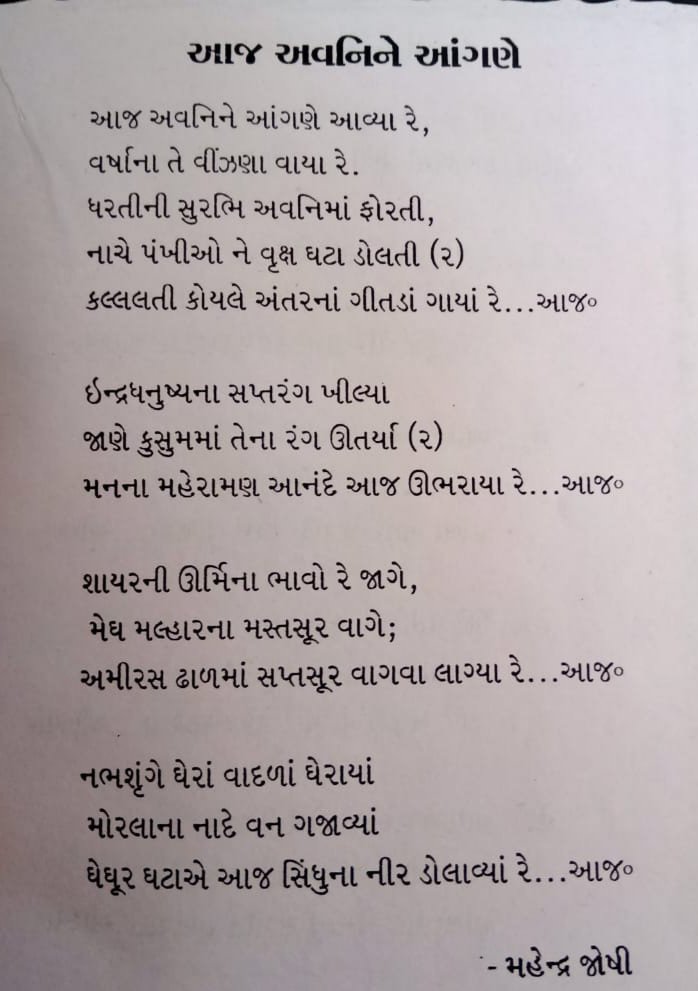
6. Refer to the Indian seasonal grid. If you can, please read small Gujarati, Hindi or English poem from the Archetypal approach & apply Indian seasonal grid in the interpretation.
According to Hindu scriptures, the 6 seasons are:-
1.Spring
2.Summer
3.Monsoon
4.Autumn
5.Pre-Winter
6.Winter

    Here poet talks about the 5 different seasons in this above poem through the student.

Five different seasons are:-
●Spring
●Summer
●Autumn
●Monsoon &
●Winter

In this above poem we find that poet talk about monsoon.poet try to gave beautiful view of monsoon. When monsoon come what happened it's is tell in this poem by poet.
When rain is come birds and trees are dancing and singing. Specially peacock is specking. We find rainbow in sky in monsoon time. So poet how beautifully represent all that things which is happening after the raining.

Thank you....

Assignment_Paper_209